Kom Ombo and Edfu - such unique names are definitely worth titling a post after. What are they, you ask? They are two small villages on the Nile, both with ancient temples named for the towns that are home to them. After seeing the sites in Aswan, we arranged for an air-conditioned mini-van to take us to Luxor, but along the way we stopped at these two temples. We took turns braving the fierce heat to see them, while one of us stayed with the kids in the cool air.
First, we entered the Temple of Kom Ombo. It was much more complete than the ruins on Elephantine Island, and more like the Temple of Philae (and in fact was built around the same time period as Philae). It was built during the reign of several Ptolemies, from about 180 BCE onward.
 For some perspective, there is little me in front of the temple.
 Josh can barely contain his excitement.
 According to Wikipedia, the temple was dedicated to Horus the Elder (the falcon god) and Sobek (the crocodile god), pictured on the wall of the temple. Living on the Nile placed the Egyptians in a special relationship with the crocodile. Several mummified crocodiles have been found in catacombs near the temple here.
 Sobek the crocodile god, god of fertility and co-creator of the world, is pictured again.
 One of the most exciting parts of viewing the temples is that everything is available to all of your senses - including touch.
 From wall to wall and column to ceiling, the surfaces are filled with hieroglyphs!
 Josh and Bud in Kom Ombo.
 Bud and Ashley
 Ashley surrounded by messages from the past.
Our next stop was Edfu, a humongous temple second in size only to the Temple of Karnak in Luxor (which we will come to later!) and one of the best preserved in Egypt. It was built between 237 abnd 57 BCE. The inscriptions on the temple walls give information regarding its construction, creation myths, and the conflicts of Horus and Seth.
The most important myth for the ancient Egyptians of the New Kingdom (generally referred to as 1550 to 1069 BCE, its most prosperous time) is the myth of Isis and Osiris, also involving Horus and Seth. Images and text from this myth are everywhere in ancient Egypt. As expected, there are many variations of this myth, but one of them goes as follows: Osiris was a ruler of Egypt married to Isis, goddess of motherhood, fertility and magic. However, Osiris' older brother Seth was so jealous of him that he plotted his death, creating a human-shaped coffin fitted perfectly to Osiris. At a party, Seth had everyone "try on" the coffin, and when his brother's turn came, he slammed the lid shut and threw the coffin in the Nile. Isis searched for her beloved husband, and, finally finding it, she left it by a tree. Seth appeared once more and dismembered Osiris' body into 14 parts, scattering them throughout Egypt. Isis again searched long and far for her husband's body parts. She found 13 of the pieces, missing only the crucial one. So, she simply fashioned a phallus out of gold, revived her husband, and conceived a son. Osiris, now dead-but-alive, became the Lord of the Dead, and their son Horus became Seth's perpetual enemy.
This myth became part of the cycle of death and rebirth, central to an agriculture-based society. Interestingly, the same idea was expressed in Greece with the cycle of death and rebirth of Demeter at about the same time. Also fascinating is the many striking similarities between Isis and her magically-conceived son and the Virgin Mary and her immaculately conceived son. Isis was often depicted in art nursing her son.
 Josh and I at the first entrance to Edfu.
 Bud and Misha at the first entrance.
 Josh and I before the main gate to Edfu. To appreciate the enormous size of the human forms depicted on the wall, take a look at Misha below:
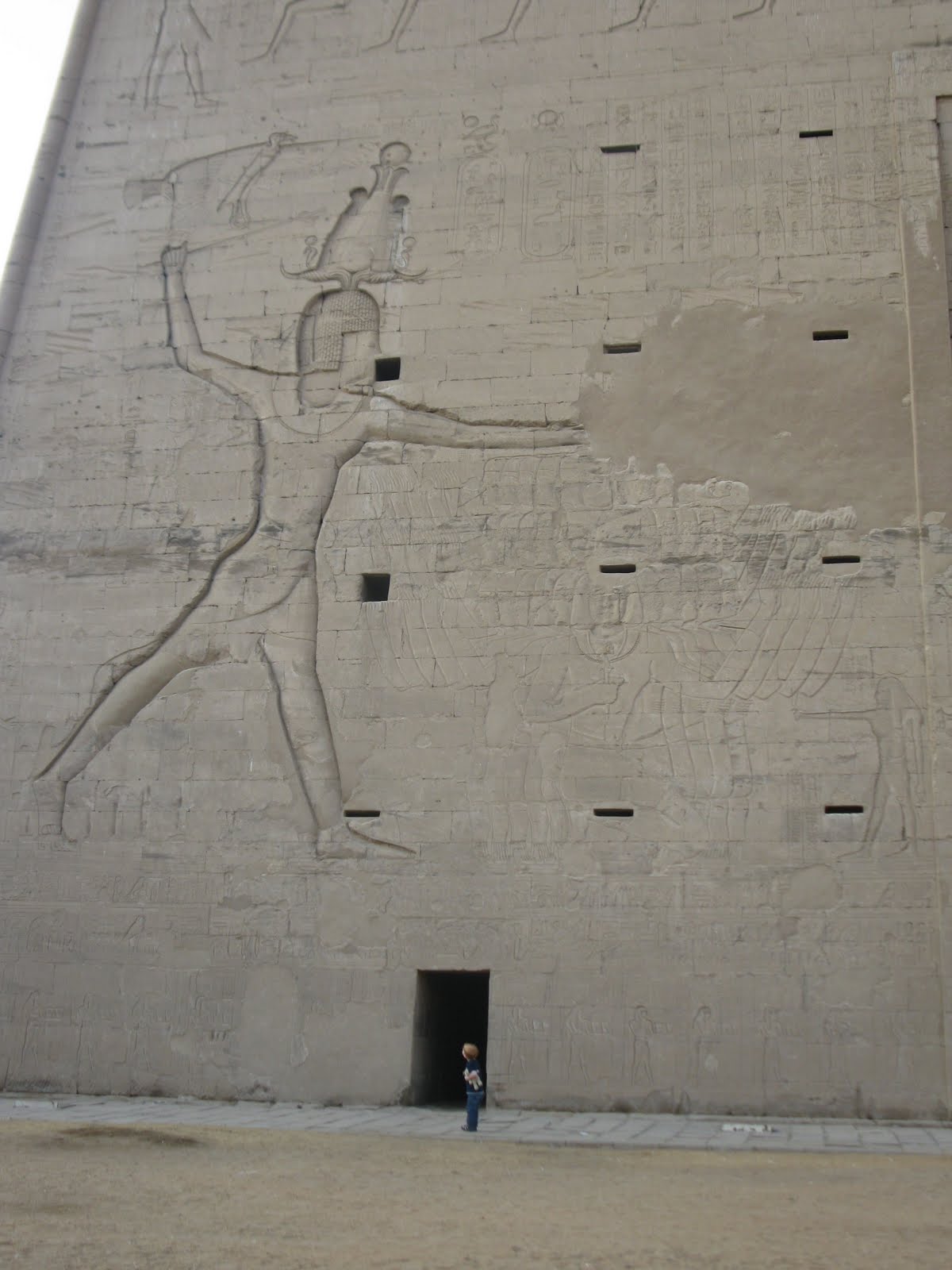 Tiny Misha looking up at a great figure.
 Josh, Bud, and Misha stand below the gods. To the right, notice the bird statue. Now compare it with Misha below:
 The inner courtyard.
 I love the pillars.
 Misha wandering through doorways. The temple was huge and fantastic for exploring. The doorways and narrow hallways went on and on, leading to small rooms, big rooms, or even more stairs and corridors. Better than Hogwarts! Misha loved investigating.
 Endless hieroglyphs.
 Off to explore inside! As you can see, we got to enjoy the temple without the crowds.
 Josh and Bud enjoy their vacation.
 Josh in an engraved hallway. The stairs wind around and around and up and up, where you can peek out of a gated doorway way up high.
 Admiring the artwork.
 Maybe he's decoding? This looks like a scene from one of the Mummy movies, when their young son is deciphering the hieroglyphs. (By the way, we just showed the first Mummy movie to Misha, and he loved it. He was excited to see the pyramids in the opening of the movie and he can't wait to watch the remaining Mummy installments!)
 Josh in front of a beautifully engraved scene.