Tuesday, May 1, 2012

Spring is for Biking


Since Bishkek is not known for its smooth roads, or its bike paths, or its conscientious drivers, we thought a long time about whether it was worth it to buy a bike for Misha. In the end, we decided to go for it. 

It so happens that we live near a large public Kyrgyz school with spacious grounds and paths that are perfect for riding on. It's surrounded by a fence and therefore it's traffic-free. On top of that, Misha's friend Vladik has a bike, so they can ride together. 

We opted for a sturdy BMX style bike that is a bit on the heavy side, but it certainly won't break any time soon. I'm sure it will withstand even the toughest of beatings. Plus, Misha will fit it for awhile. He can already ride well without training wheels, but getting started on his new bike has been a bit of a challenge since he can barely touch the ground while on the seat. He's starting to get it, and once he's on, he speeds down the paths and over bumps with no hesitation!


Vladik and Misha

Concentration

Practicing in front of our apartment

Tricks with Dad


Sebby and Daddy enjoy the park


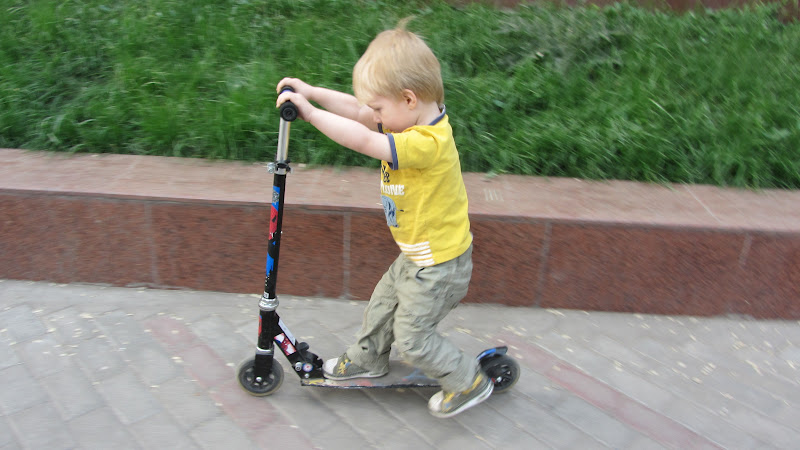
As Sebby was bluntly telling Grandma and Grandpa, "Misha got a new bike. I walk." However, that's not entirely true. Now that Misha has moved onto bigger things, Sebby has inherited Misha's scooter. Sebby loves it and does remarkably well on it, especially considering it's a 2-wheeled scooter, not 3.

At home, he gets a chance to perch on Misha's bike.


If we had any remaining doubt about whether buying the bike was a good idea, I think this photo clears that up!

Spring in Full Swing

Our apartment window looks out over the courtyard playground where the boys play.
Spring in Bishkek seems to come all at once, exploding from bare branches to green buds and leaves from one day to the next ... not at all like in South Dakota when spring comes tentatively, little by little. At the very end of March, Bishkek looked grey and barren. Just a few days later, lawns were sprouting, weeds were thriving, buds were appearing, and the everything was filled with green.

My father mentioned how Russian authors remark upon the same phenomenon, describing spring as simply "bursting" forth. I found a quote from Lev Tolstoy which does just that:

"The sun shone warm, the grass, wherever it had not been scraped away, revived and showed green not only on the narrow strips of lawn on the boulevards but between the paving-stones as well, and the birches, the poplars and the wild cherry-trees were unfolding their sticky, fragrant leaves, and the swelling buds were bursting on the lime trees; the jackdaws, the sparrows and the pigeons were cheerfully getting their nests ready for the spring, and the flies, warmed by the sunshine, buzzed gaily along the walls." (Resurrection)


These words fit Bishkek quite well too. Though a drab and rather depressing city in the winter months, in spring Bishkek is beautifully overgrown with wilderness. Trees grow in the middle of sidewalks; tall grasses and dandelions push their way through cracks. Branches are never cut back but allowed to thrive as they will. The air is filled with fluffy cotton from the Cottonwoods and flurries of Elm seeds showering down. Everything is growing wild and free.

At the beginning of April, Bishkek looked like this:


and this:


and a few weeks later, it has transformed into this:

This is how I picture the "Secret Garden" would look.


To get into the spring spirit, the kids and I bought some seeds and planted them outside in front of our apartment -- zinnias, carrots and peppers. So far nothing has come up yet, but it has been raining lately, so we could get lucky. A few flowers that we planted in the house have already started growing, much to Misha's delight.


More spring shots:


Also in the spirit of spring, we found a caterpillar and took him home. 


He immediately decided it would be better to metamorphose than to live in a cereal box ...


... and now he rests peacefully inside his very cool-looking pupa. We are hoping that Grandma will look in her insect guide to tell us what kind of butterfly or moth to expect!

What's better than a sucker on a nice spring day?


What a cheesy grin!

Misha's too!


A double-scooter ride

Walking over the train bridge.


Learning some climbing tricks from a neighbor girl


Sebby enjoyed climbing with these two girls. They made monkey sounds and exclaimed, "Ya obezianka!" Sebby joined in, "Ya toje obezianka!" - I'm a monkey too!


Happy spring!

Saturday, April 28, 2012

Two Easters


Until this year, I hadn't realized that the Eastern Orthodox Church's Easter falls on a different date than the Catholic tradition's celebration. This is because the Eastern Orthodox Church follows the Julian calendar, instead of the Gregorian. Both holidays fall on different dates every year. This year, the Orthodox Easter fell one week after the Easter we are familiar with. 

Kyrgyz people (being Muslim for the most part) don't celebrate Easter; however, the Eastern Orthodox Easter is a significant holiday for Russian people. The traditional Russian Easter breads appeared on the streets in the days before the holiday. Called kulich, the breads are tall, narrow loaves with raisins inside, topped with white icing and sprinkles. As I walked Misha and Sebby home from school, we would buy some of these little loaves to munch on.

The Russians also attend a special church service on Easter night. We were invited and would have liked the chance to see it, but a few things deterred us. The main drawback was simply the fact that the service started at midnight and lasted until 3 a.m. Traditionally, everyone remains standing for the entire service. People dress in dark, drab colors and congregate in the church. The pastor then recreates the light of Jesus returning to the world in an involved ceremony, and everyone walks throughout the church lighting candles. The service culminates joyfully and everyone participates in a feast. Since we had school and work the next day, we decided that trying to make it to the service would be a stretch!

However, on our familiar Easter date, we did manage to dye some eggs:


Then the kids hid them for Daddy to find. Sebby was so excited he was screeching at the top of his lungs and pointing out the exact location of the eggs, as if he were shocked to find them where he himself had hid them!


Let the hunt begin.


We re-hid the eggs so many times that most of them had cracks in them by the time we were done (but we only hid the hard-boiled ones) and we were missing a few of the eggs. These turned up a few weeks later ...  and I hope none are left rotting in the living room behind the couch!

Little Linguists

Misha and Sebby join the slide madness at the park in front of our apartment.

Josh and I still can't get over how good our kids have gotten at communicating in a second language. After a solid six months of Russian immersion at school every day, the kids do just fine in school and at the playground without relying on English. Now that the weather is so ideal, we have been playing outside with the children in our area. And since the boys are able to understand so much more now, it is much more rewarding for them as they socialize with other kids and improve their Russian at the same time.

Two girls join Misha to dig up dirt for our flowers.

Misha can really hold his own in Russian. There are always new words that he doesn't know, of course, but he's great at using context to understand the meaning. On top of that, his accent is so good that it leaves his parents feeling extremely envious. Misha now corrects our pronunciation. For example, when I say words, like быстро ("fast"), he tells me, "Mom, it's not beestra, it's bistra." (The Russian letter ы is a sound we do not have in English, and most adults learning Russian find it a bit tricky. It's like putting your mouth in the shape to say "eeee" but trying to say "i" as in "pig.")

Misha and Vladik on scooters.


Now that he is almost ready for first grade, he has started bringing home math homework and short texts to practice reading in Russian - sometimes about elephants, sometimes about dogs who traveled in space. To help Misha learn even faster, we found a teacher to give him extra lessons a few times a week. These home “classes” aren't really work; they're mostly fun conversations and having stories read aloud as a way to learn new words. We always hear Misha jabbering away in Russian and laughing during his lessons!

A three-person hug with Alihan

Misha and Sebby both have a natural sense of the language. When they hear Russian spoken around them, they switch immediately to speaking their second language. Misha knows more vocabulary than Sebby, which is understandable since a seven-year-old's world is much bigger than a three-year-olds. However, we are constantly surprised when we hear how well our little Sebby can speak Russian in complete sentences. When our friends come over and ask him questions, he responds easily and naturally. If they ask him what he did, he might say, “Ya mnoga paspal. Ya pakushal.” (I slept a lot. I ate.) Last week my friend asked him, “Gdye Misha?” (Where's Misha?) and Sebby launched into an explanation: “Misha nietu; on tuda uyehal.” (Misha's gone, he went over there.) After school, we sometimes ask Sebby "Chto ti kushal?" (what did you eat?) and he pipes up immediately, "Soop i hleb!" (soup and bread).

Saule teaches the boys a Russian hand-slapping game.

In many ways, Sebby's youth has really given him the chance to learn a second language completely naturally. Sebby has learned the language purely through situations, without using translation. Young children Sebby's age don't even understand the concept of translation. They have learned a set of words in their first language, and separately they have learned a set of words in their second language. They can use both sets of words very well. If you ask Sebby “Do you want water?” he will say “Yes,” just as if you ask “Ti hochish vodu?” he will say “da.” But if you ask him, “What is 'water' in Russian?”, the question doesn't even make sense to him. Since he has learned all of his vocabulary and expressions naturally, he speaks very well, with a more natural sense of grammar than adults.


To take one example, Sebby uses the expression “I have” perfectly in Russian. To say “I have an apple” in Russian, you say “u menya yest yablaka” - which word-for-word means “To me there is an apple.” Misha sometimes says it incorrectly in Russian (“Ya est yablaka”) because he's thinking of the English equivalent in words. Sebby, in contrast, learned the phrase as a whole without translation, and I hear him say “u menya est!” and “u menya nyet!” (I have it!, I don't have it!) just as Russian children do.


Being older isn't always a drawback, though. Misha has the advantage of knowing and appreciating the differences between languages. He finds words interesting and he often asks, “Why does Russian say it that way?” He also has a lot of chances to share knowledge with his classmates. They ask him words for objects in English and in turn he asks them the Russian names for things. Also, we have noticed that Misha is starting to pick up the correct endings for words, simply from listening to Russian all day. Russian has six cases, which means word endings change to reflect what part of speech they are used as (like German, which has four cases). Both boys have made so much progress already that we can confidently say they will be extremely comfortable in Russian by the end of next year!

The wonderful thing about Bishkek is that Russian isn't the only language you hear on the street. Kyrgyz is prevalent also (even though some city Kyrgyz people don't know their own language well and prefer to speak in Russian), and Kyrgyz language is a required subject in schools. That means that Misha knows a good handful of words in Kyrgyz, such as colors, numbers, and animals, as well as several Kyrgyz songs. Sebby also hears Kyrgyz at school, and sometimes I hear him say Kyrgyz phrases, like “chong bala!” (big boy) and “Bul emne?” (what's that?). 


Misha and Sebby with Vladik

Now for an interesting story about Misha's friend Vladik:
When Josh and I were in Kyrgyzstan the first time, we taught a Russian guy named Pasha, who worked as a guard for the U.S. Embassy. Pasha's wife had just had a baby, and I was pregnant with Misha. After Misha was born, we started to hang out with Pasha and his wife Marina, and the kids - Vladik and Misha - would play. When we went back home to America, we lost contact with them. However, by a funny turn of events, when we came back to Kyrgyzstan in September, we realized we are neighbors with Vladik's family. On top of that, Vladik now has a little brother Yarik who is less than a year older than Sebby.


This photo shows Misha and Vladik together in Kyrgyzstan the first time around, when they were about a year old. :)