Showing posts with label Islam. Show all posts

Wednesday, June 22, 2011

Road Trip #2: Mada'in Saleh

Archeologically and historically, one of the most significant sites in all of Saudi Arabia is Mada'in Saleh, where 131 tombs were carved into the sandstone in the north-western desert by the Nabatean people (famous for Petra) between 100 BC and 100 AD.

It would have been a shame to miss such a site during what is likely our only experience living in the Kingdom, so when some friends of ours organized a weekend group tour this April, we joined in. We are happy that we did - the trip was one of the best things we've done in Saudi Arabia. It was well worth the 10-hour drive (one way) to get there.


The Nabateans' first city was the world-famous site Petra, 500 km north-west and built considerably earlier, about 6th Century BC. Mada'in Saleh, also known as al-Hijr ("Rocky Place"), is the second city of these same people, a city which thrived due to its strategic location for trade. Incense, spices, frankincense, and myrrh made their way from the Arabian peninsula to the Romans, Greeks, Egyptians, Syrians and others - but only by passing through the Nabateans, who placed a 25 percent toll on all traveling goods. The city fell to the Romans in 106 AD and lost its claim to riches when travel routes moved to the sea.


The huge sandstone tombs are open to the public, but they receive few visitors. First, it's not easy to get to Saudi Arabia in the first place unless you have a work visa. Second, the site requires permits and a guide arranged in advance. Third, since the ruins are pre-Islamic, they are not given considerable importance. And lastly, the site has a reputation for being haunted by evil spirits.

The Legend: Long before the Nabateans, in 3000 BC, lived the tribe of Thamud. According to the Qur'an, the Prophet Saleh warned the Thamudis to stop worhiping idols and repent. The people scoffed and challenged Saleh to perform a miracle: summon a pregnant camel from the mountains. When Saleh succeeded, the people angrily killed the camel instead of changing their ways. Just three days later, the city was destroyed in lightning blasts and earthquakes, and to this day, the tormented souls prowl the area after dark. This account is still associated with Mada'in Saleh (which means "Cities of Saleh"), so much so that one of my supervisors advised me to be careful of the spirits on my trip, especially with children.

Despite the legend, Saudi Arabia is now trying to promote the site for tourism. It was made the Kingdom's first UNESCO World Heritage Site in 2008.


The impressively carved tombs were burial places for individuals or families. Their dwellings were elsewhere and are still being excavated. As you can see from the photos, the tombs had elaborate, high facades with eagles, snakes, winged lions, faces, or urns carved above the doors. The general style mimics the carvings at Petra, especially the stair-steps at the top.


The inside of the tombs are considerably plainer and smaller, nothing more than a gouged out space with body-length cubby holes dug into the sides - shelves for corpses.


Our large group consisted of four car-loads of foreign teachers, all following a security jeep with our guards and guide, stopping now and again to explore the tombs to our hearts' content. Misha loved climbing up to the doorways and walking around inside. (Due to the long car ride and the desert heat, we decided to leave Sebby with our capable babysitter Sumayya - a decision that turned out to be very wise.)

In addition to the eeriness of being surrounded by ornate tombs in the middle of the desert, we also appreciated the sheer natural beauty of the bizarre rock formations. Some visitors have described the terrain as misshapen muffins or mushrooms or smokestacks. Misha thought they looked like stacks of pancakes, while I likened them to melting ice cream scoops.

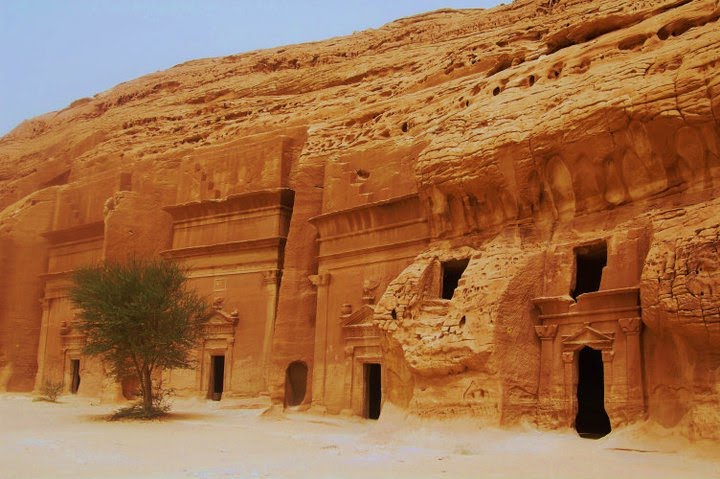


This very large room was thought to be the Nabateans' meeting room. Its impressive 8-meter ceiling has a beautifully carved moulding around it.


This tomb, called Qasr al-Farid, was carved into one gigantic rock. The inside, however, is unfinished - simply a small, gouged-out room.

Our group assembled at the doorway gives an inkling as to its size.

Even closer: Misha and Josh stand in its doorway.


Josh and Misha traipse through the surreal landscape.


The double tomb.


At the top: Josh takes everyone's picture, with our guide, after an upward hike. Since we were in an area with only a handful of visitors besides ourselves, our guide told us we were welcome to take off our abayas. In fact, he said I could even drive if I wanted!


These camels greeted us at the entrance to the site.

Getting to know you.


Late Aramaic inscriptions adorn some of the tombs.

The Hejaz Railway: After seeing the tombs, our tour took us to the famous Hejaz Railway, just a short drive away. Built by the Ottoman Empire between Damascus and Medina, its goal was to connect Constantinople to the holy pilgrimage site of Mecca. However, though the railway reached Medina by 1908, it never made it to Mecca. It was destroyed by Lawrence of Arabia and the Arab tribes in 1917. Remnants of this railway still exist, like this station, some rail, and an old World War I locomotive.


Hands-on fun for Misha

The station

Old Town: After the railway, we were treated to seeing the Old Town of Al-Ula, the now deserted but preserved mud-walled city with its own overlooking fortress. We couldn't find much information to date its inception - probably because it had been continuously lived in until not too long ago. It was amazing to walk its crumbled, tunnel-like corridors. It felt like going back in time, until we stumbled upon a fuse box that had been inserted into one of the walls.


The modern city of Al-Ula was built right beside the old. I really enjoyed the general feel of the city, so different from the impersonal, new, huge Riyadh. Unlike in Riyadh, the homes in Al-Ula were not surrounded by walls, creating a feeling of sincerity and friendliness. Fountains and artistic gates also gave the city personality. The people seemed friendly and shy, not used to foreigners. A young girl in an abaya called out "I love you" to me as I passed her in the Old Town - probably the only English she knew.

To bring our tour to a close, we got to see Elephant Rock. I had seen photos of it before, but I had no idea it was so large!
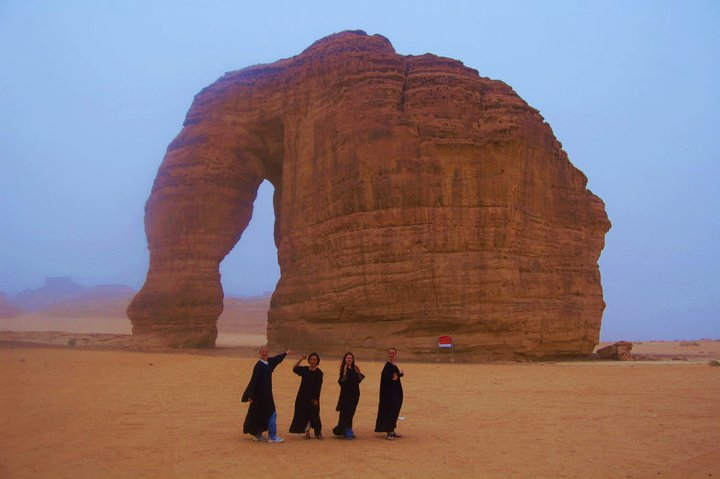
I have to admit that sometimes the abaya is very picturesque. I am on the left with friends Tung Chi, Becky, and Georgina.


Becky and I present "Cartwheels in Abayas."

On the Road: Part of the fun of the whole experience was the drive. Counting our previous road trip to Al-Khobar in the east, we have now driven horizontally across nearly the entire country. Once again, we got to watch the changing desert and enjoy wide, smooth highways and the views of the camels. What is amazing to me is how few cities we passed. During our 10-hour trip out, we passed through only two cities, first Qassim and then Ha'il. There were other villages off the highway, but most of the land is an empty expanse. Gas stations are plentiful, however, staffed by lonely foreign workers who commute to their post every day. There is only one stretch which requires great care to fill up your tank to the brim before attempting to reach the next city.

We drove through one significant sandstorm, in which dust mixed with fog to create a pinkish white haze for almost two hours. When we stopped at a rest stop for a bathroom break, the dust seeped into our eyes, noses, and cars - giving us all an immediate case of sneezes and itchy eyes.

I was greatly entertained by the signs. I managed to snap shots of my favorite two - first, this sandstorm warning sign, and below, the oft-seen camel crossing.


This mom and baby were penned up at one of our rest stops.

And these held their heads high as we passed them on the way back home.

I'll conclude with a fact that will make you all jealous. We spent only $30 in gas to get our vehicle (a Hyundai Elantra) through the entire journey. That's a total of 2,200 km (over 1,300 miles).

Note: We are back in South Dakota now for the summer, but I have a few more posts to share to get caught up. Stay tuned.


Saturday, December 18, 2010

Matchmaker, Matchmaker

One of the things that jumps to people's minds about marriages in Saudi Arabia is the fact that they are arranged. And since their society segregates the genders from even the most innocuous mixing, getting married is a huge step into a very different world for both the bride and groom. My students, like all Saudi women, socialize only with other women, attend school with only women, and even party with only women. Likewise, the men socialize only with other men. As this is a considerable contrast to relationships and marriages in America, I have always been curious to get my students' thoughts about their customs.

Discussing weddings is perfectly fine in class, but when it comes to religious issues, we foreign teachers must be quite delicate. So, my discussion topic was simply Saudi weddings, and I asked them various questions in small groups and learned all I could. Since I have gotten to know them now for several weeks, I feel I can ask them for their honest opinions. They are always eager to share their traditions.

A lot of them love dressing up and buying expensive dresses ($1000 or more for a fancy wedding) – and of course, they say you can't re-wear a dress to another wedding unless there is an entirely new set of guests! Since they come from large families (they generally have between 3 and 10 siblings, sometimes more), going to a wedding is a very common event here. Weddings are, naturally, segregated. Basically, for these girls, a wedding is a chance to dress up, eat, talk, and dance ... with other dressed-up women. At some point in the long, late evening, they may have a chance to glimpse the bride and groom together, but only if they cover their stunning dresses and hairdos with their abayas and scarves. On the men's side, the guests sit, talk, and have a meal. They never see the bride unless they are directly related to her. After the wedding, the couple takes off on a honeymoon – which often lasts a whole month as the name implies, and almost always involves destinations outside the country, such as Malaysia or Europe.

Most university-aged women today are not yet married. In fact, most of them have no desire to bear the burden of a husband and family any time soon. They are content to enjoy their freedom and friends and to pursue their studies. Most want to graduate and have a job before they even think about getting married. Some of them have had marriage offers but have refused. Of course, it was different in the past. The majority of my students' mothers were married at around age 18, and most of their grandmothers were married between 10 and 15. Can you imagine being married at 15? I asked. They shook their heads, eyes filled with relief that they did not share their grandmothers' fate. These girls - with their education, Blackberries, designer clothes, and private pools - can no more imagine being a wife at 15 than I can.

Since marriages are arranged in Saudi, there is virtually no chance of choosing one's spouse. However, marriages to cousins are quite common. Some girls find this a positive factor, because they have a better chance of knowing the boy if they have played with him as a child or grown up with him around. Some girls, however, dislike this tradition, especially if a girl is matched up from childhood with a fellow cousin and given no choice in the matter. When I asked if parental pressure is a large issue with marriages, I got mixed answers. Some told me that there was absolutely no pressure and that the final decision to marry someone rested with the woman. Others told me that within some families there is intense pressure, leaving the girl, and often the boy as well, with virtually no say.

It is the man, with the help of his mother and sisters, who actively seeks a bride. If his mother recommends someone, the man will approach the woman's father to arrange to meet her. This "first glimpse," which can last anywhere from five minutes to perhaps a half an hour, is the first time a woman is uncovered around an unrelated man. Naturally this produces plenty of anxiety for her! The woman's father is also present, but he may leave to allow the couple to speak privately for a short time. I asked the girls what they would say to a suitor. They either giggled or looked horrified and said they wouldn't say anything unless asked.

After this first glimpse, if both of them wish to continue seeing each other, they must sign a 'promise' of sorts that makes them a legal couple. They are then able to see each other in public, call each other, etc. during their engagement period. At an engagement party, the man presents expensive jewelry to her and pays a hefty dowry. As in our culture, the engagement can last a few months up to a year or more. If a girl gets engaged while in university, she will often wait until she finishes to have the wedding. Unlike in our culture, however, the engagement is an actual marriage contract, and breaking it technically means that the couple has divorced. I asked if the woman can change her mind during this engagement period, and they assured me that yes, of course she could. The wedding can be canceled, but she would still be considered divorced, despite never having enjoyed any of the significant perks of being married. (The couple can not live together until after the wedding, though the actual wedding party involves no ceremony. It is strictly a time to celebrate.). I then asked if breaking the engagement was embarrassing. Some told me no; it was up to the woman and she could break the contract with no serious problems. One girl's sister had done just this. Others, though, told me that yes, it was embarrassing – especially to be stuck with the "divorced" label.

The whims of men seeking brides have produced some amusing stories. One girl said her sister was in a candy shop and a man was so taken with her (despite her being covered) that he approached her parents and asked to arrange a meeting with her. Her parents refused, saying that their daughter was not a piece of candy. That was the end of that. Another girl told me a story about a man who saw a photograph of a woman on a birthday cake and immediately asked the store employee for her parents' contact information so he could marry her. It's hard to imagine things like this happening in any society other than one that keeps women so far out of the reach of men.

Eventually I wound my way around to asking the girls what they thought of their marriage system. Did arranged marriages work well? Did they wish they had more choice in who they married? I was actually a bit surprised at the responses. As I had expected, many of them said arranged marriages are an Islamic tradition and that their parents know best whom they should marry. Close to half of them, however, said they wished that they had opportunities to choose for themselves. Why? "Because how can I know if he is a good person?" they said. Five minutes is an awfully short time to judge that.

Only one of my students is married, and one is engaged. The one who is engaged said she saw her fiance for only five minutes at their first meeting. After deciding to continue the relationship, she received a special necklace from him and they are now able to get to know each other during their engagement. They can call each other and meet occasionally. Luckily, she seems very happy.

With just a few of my small groups, I broached the subject of multiple wives. I started by saying, "In Islam, a man can have four wives, right?" They said, yes, that's right, but the Qur'an stipulates that this is allowed only if he has the means to provide for them and only if he treats them all equally. Unfortunately, this rarely happens in real life, where wives often simply reflect on the man's social status. Somewhat awkwardly I asked, "So ... if your husband wanted another wife, would you be ok with that?" The answer was immediate: "No, Teacher!" they gasped. "Would you want that?? I would tell him to divorce me first! No woman would want that."

I know that many of Josh's students have fathers with multiple wives. I didn't outright ask my students if their fathers had more than one wife, and no one volunteered that information if they did. However, I asked about their grandfathers, and several of their grandfathers had two wives. Naturally, wives of the same husband can have rocky relationships. One girl has two sisters, both second wives of their respective husbands. One sister fights constantly with her husband's other wife, while the second sister actually gets along great with the first wife. Sometimes, they told me, a man will take a second wife to get revenge on his first wife if she doesn't treat him the way he demands. But sometimes, the husband and wives work together more productively. One of my students has an aunt who couldn't get pregnant, so she herself chose a second wife for her husband. Ironically, both women then got pregnant and they raised their children together!

Monday, July 12, 2010

Ah, summer vacation


We leave for Egypt tomorrow! Our last working day was the middle of last week, so we have had about a week in Riyadh to relax, go shopping for the kids, and run errands. We've been particularly busy with getting everything settled for our residency permits, which have to be in order before we leave the country. So many hoops to jump through! And Josh, being the man, gets to do most of the dirty work of finding out where official places are, figuring out when they open, and deciphering what documents they need. It's a process. We'll be doing more paperwork in Cairo before re-entering the Kingdom.


Misha joined me on campus for my last day of work so he could register for the kindergarten there for fall. (That has been a headache of paperwork as well!) It will be so great having him one building over from me. Plus, he'll learn lots of Arabic in this school. During our day on campus, I tried to keep him entertained. We spent a little time in the garden of palm trees - but not too much, because it was so hot.


Misha in the teachers' office room.


The boys enjoy the pool on a hot afternoon. We always swim after 5 p.m. to avoid the worst of the sun.


We ventured outside of the compound to this nearby park. I was feeling rather depressed about being stuck in my big, long abaya, which discourages me from playing much with the kids, like taking Sebby down the slide. But it's a better way to interact with people in the area. I talked to another mother in my limited Arabic, and Misha made some buddies by sharing his new sand toys.


The Chili's restaurant, as we discovered serendipitously, has a great shaded park in back for kids! I think Misha had more fun here than anywhere since we've been here.


This is Enid, our wonderful babysitter for Sebastian (and for Misha when he has days off from preschool). Before we left for the summer, we wanted to take her out for dinner - thus, the Chili's expedition. It was a nice evening.

It's funny how Sebastian has realized that the abaya means someone is leaving. When Enid would come in the morning, Sebby would start to whimper as I put on my abaya to leave. When I came home after work and Enid put on her abaya, he knew she was heading home and he would start to wave goodbye.


Sebby falls asleep in funny places. He fights sleep until he's simply too tired to hold his head up, and he conks out right on the floor. Misha kindly put a sheet over him. ;)


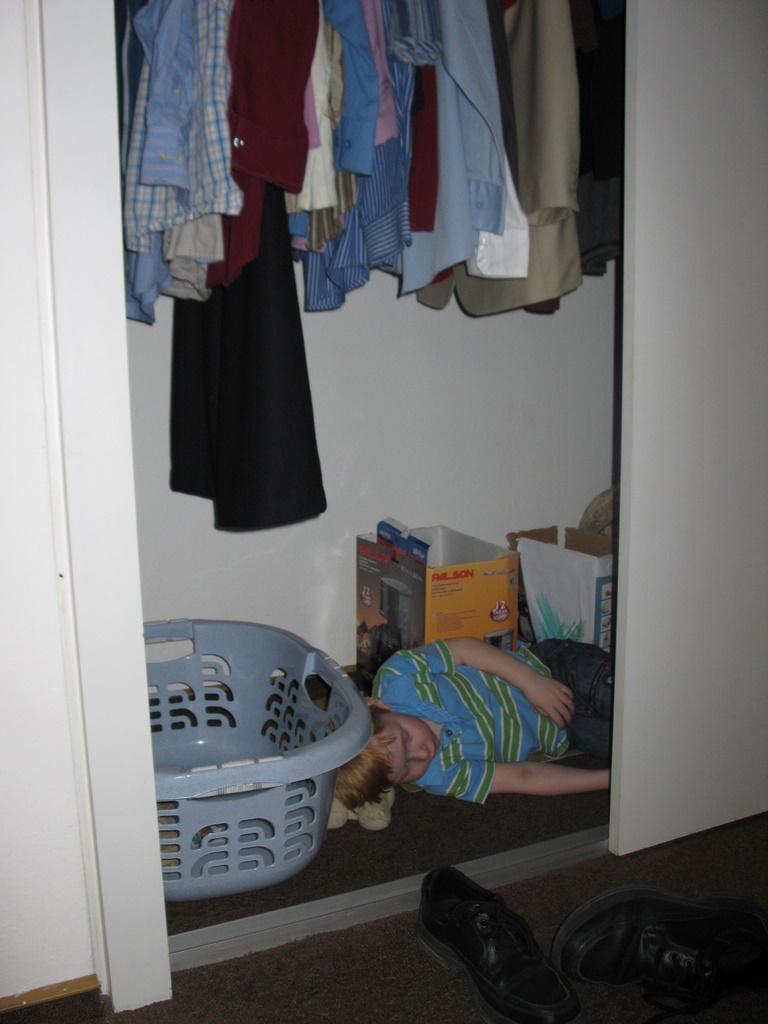
On that same day, Misha fell asleep in the closet!


Both kids still have an affinity for crowding into small spaces.


And Misha is forever doing his projects. He makes all sorts of creative things, like this elephant trunk. He does get homesick, especially for his relatives in the US, but he has been adjusting well particularly these last few weeks. Lately he has been talking about building a rocket, or wings, or a tunnel, or a special computerized way to travel back and forth from Saudi Arabia to America. That's quite a task! He gets so involved in his projects that we have to tempt him out of the house to do errands by promising a ride on the roller coaster.


Another project - a papier mache mask.


You can often find Misha with a pencil in one hand and his special bear, Growl, in the other.


Misha in my abaya. When I asked him why, he said he was cold.


Josh and I have had a little extra time to wander the Dira Sooq some more. Here we are outside of Masmak Fort.


We took Misha out to eat at Fuddruckers - and gave him the chance to play a few games.


Driving a Hummer in Toys R Us. Many people actually own Hummers here - it comes in handy when you want to drive over a curb, as so many drivers to do maneuver to a better position.


My first trip to Riyadh Gallery (another mall). They have a beautiful landscaped scene where you can sit and drink coffee while admiring the stuffed animals.


Misha showing off his new clothes.


Hat shopping for Sebby.


Eyeing the dresses - this one sells for 1000 Riyals. ($260)


And of course, we made sure some of our time this past week was spent on mall rides and games. Misha loves this miniature air hockey table. The best part is that since air hockey requires no attendant, it is open during prayer time. Misha played over and over during the break. He even played several games against other kids - he liked that a lot more than playing mom and dad.

Prayer times at this time of year happen at about 3:15 a.m., noon, 3-ish in the afternoon, 6:30 p.m., and 8:00 p.m. Times vary depending on when the sun rises and sets. The first prayer happens at dawn - and if you don't believe that the sun actually rises at 3:15 in the morning, just ask Josh. He was awake quite late one night and he has confirmed this phenomenon. We were amazed.

Each time prayer hits, all stores close down for about half an hour. In theory it doesn't seem like this would matter so much, but in reality, it is uncanny how often we arrive at a store only to find that the gates are closing. In a city where so much time is wasted in traffic, it is hard to be patient for even longer when a store is closed for prayer. We try to schedule our outings so as not to run into more than one prayer time - but it's not easy!

The best time to go shopping is in the morning. Most places are open by 9:30, giving you several hours until noon prayer. Most places close in the heat of the day from 12 to 4, at which point they open until late into the night, sometimes until 11 or midnight. Most of the Saudis like to shop after the last prayer, which means shops are incredibly crowded at night and filled with families with children.


The boat ride.

Another favorite - bumper cars!

Big guy in a little car.

Misha on display!

Dad and Misha in the mall.

Me with the kids in Gap.